This site is intended for US Healthcare Professionals

Mason is a real VILTEPSO patient and a compensated spokesperson.
VILTEPSO is an exon-skipping therapy that has been granted accelerated approval based on its demonstrated increase in dystrophin in DMD patients amenable to exon 53-
skipping therapy.
By week 24 of treatment in the pivotal 24-week study, VILTEPSO increased mean dystrophin levels to nearly 6% of normal vs. 0.6% at baseline.
In the pivotal 24-week study, VILTEPSO increased dystrophin levels in 100% of patients.
Exon skipping is a therapeutic technique that helps produce dystrophin in patients with DMD by “skipping over” an exon next to deleted exon(s).
VILTEPSO corrects out-of-frame mutations by skipping exon 53 of the dystrophin pre-mRNA. It is designed to produce a shortened dystrophin protein containing essential functional portions.
Nearly 50 DMD mutations are amenable to treatment with VILTEPSO. Patients with common mutations, including 45-52,
47-52, 48-52, 49-52, 50-52, and 52, are
eligible for treatment with VILTEPSO.
Genetic testing can be used to identify a DMD patient’s specific exon deletion range. This Exon Finder Tool can help you determine whether that range is amenable to exon 53-skipping therapy with VILTEPSO.*
*This tool is not intended to deliver a diagnosis or to replace discussions with a patient’s doctor or genetic counselor.
Enter the range from your DMD patient’s genetic test (e.g., “45 to 52”) into the fields below.
If only one exon is deleted, use that number for both fields (e.g., “52 to 52”).
How VILTEPSO supports dystrophin production in amenable DMD patients.
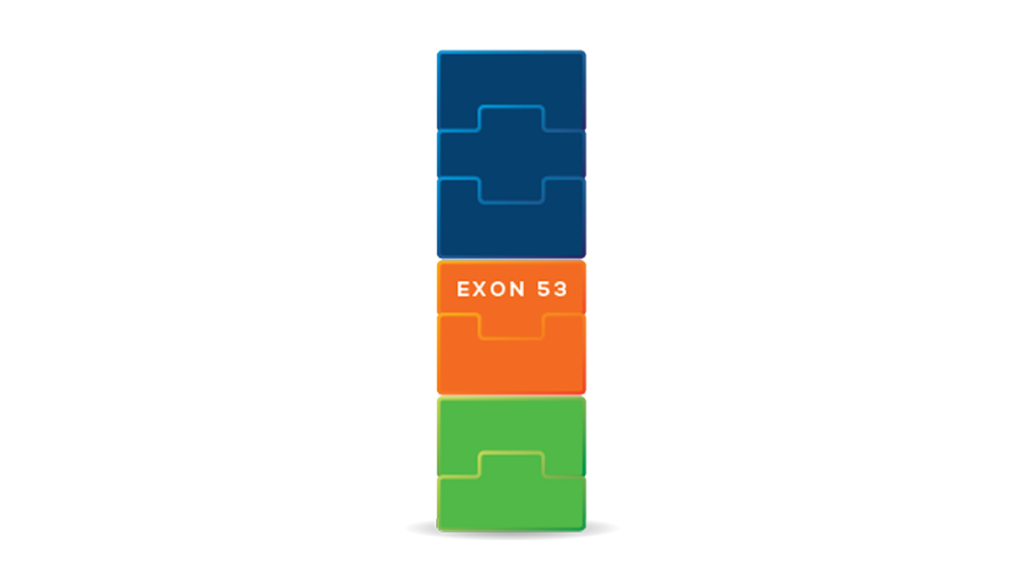
The Duchenne muscular dystrophy (DMD) gene is made up of individual pieces called exons. These exons work together like building blocks to tell the body how to make a full-length dystrophin protein.

A mutation or deletion in the DMD gene may impact the way its exons fit together. As you can see here, exon 53 has lost its connecting partner, which prevents the body from making enough usable dystrophin to support skeletal muscles.
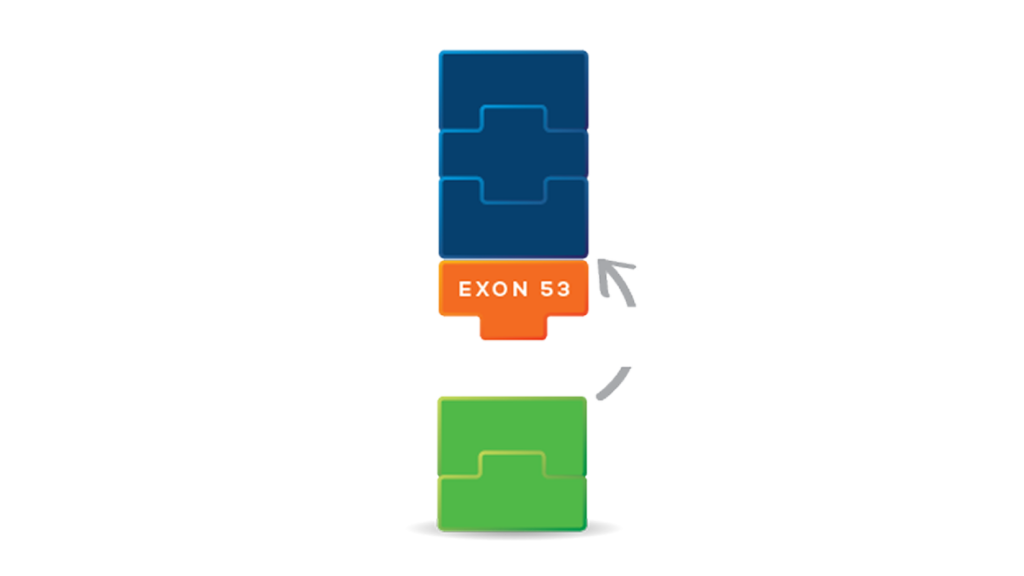
In DMD patients amenable to exon 53-skipping therapy, VILTEPSO is designed to “skip over” exon 53. In this case, it skips over the orange block (exon 53) so that the green block can fit next to the blue one.

By skipping exon 53, VILTEPSO helps the body make a shortened but partially functional form of dystrophin protein.
VILTEPSO is indicated for the treatment of DMD in patients amenable to exon 53-skipping therapy.


Explore VILTEPSO’s primary and
long-term clinical studies.
Learn about insurance coverage for VILTEPSO and other forms of assistance.
Connect with an experienced NS Pharma specialist for more information.
0:18: The genetic instructions for protein production are stored in our DNA and are encoded by genes. A gene is a small piece of DNA that sits on a chromosome and contains information for making a protein.
0:34: It is divided into sections called exons and introns. Exons contain the blueprints for protein production and are interspersed with sections of non-coding DNA called introns.
0:46: During transcription, DNA is processed by RNA polymerase to become pre-messenger RNA, pre-mRNA. Before this pre-mRNA message can be made into a protein, exons are joined, or spliced, together while introns are discarded to turn the pre-messenger RNA to messenger RNA.
1:08: The ribosome translates this messenger RNA to protein. Proteins play many critical roles in the body, including muscle contraction. The dystrophin gene normally contains the complete genetic information for producing dystrophin. Dystrophin is a protein which is needed for normal muscle function.
1:34: A mutation in this gene can result in a condition known as Duchenne muscular dystrophy (DMD). One of the most common types of mutations in the dystrophin gene occurs when one or more exons are missing or deleted. These mutations in the dystrophin gene are transcribed into the pre-messenger RNA.
1:55: However, because one or more of the exons are missing, the remaining exons do not fit together properly, resulting in the absence of a functional dystrophin protein.
2:10: Small molecules called antisense oligonucleotides, or AONs, hide or mask specific exons in a gene sequence, referred to as “exon-skipping therapy.” In DMD, AONs bind to an exon next to the region on the dystrophin gene where one or more exons are missing.
2:30: By masking this specific exon, the remaining nearby exons can now fit together, creating a shortened dystrophin protein that contains essential functional portions.