Long-Term Extension Study

VILTEPSO Was Studied Over a Four-Year Period

Mason is a real VILTEPSO patient and compensated spokesperson.

About the Long-Term Extension Study

Study Snapshot

Icon Microscop

Study Type

Phase 2, multicenter, open-label extension study
Asset 18 1

Population

16 ambulant males aged 4 to <10 years with DMD amenable to exon 53 skipping who completed the pivotal study
Icon calendar

Duration

192 weeks
(216 weeks total)

KEY INSIGHT

All patients chose to continue VILTEPSO for the entirety of the four-year study

Boys aged 4 to <10 years (N=16) with DMD were enrolled in a randomized, double-blind, placebo-controlled, 4-week safety period of once-weekly infusion of 40 or 80 mg/kg VILTEPSO, followed by a 20-week open-label study to assess the efficacy and safety of VILTEPSO. After completion of the 24-week study, patients could enroll in up to a 192-week extension study (216 weeks total). Efficacy assessments were conducted every 12 weeks.

LONG-TERM DATA

Long-Term Functional Assessments of VILTEPSO 

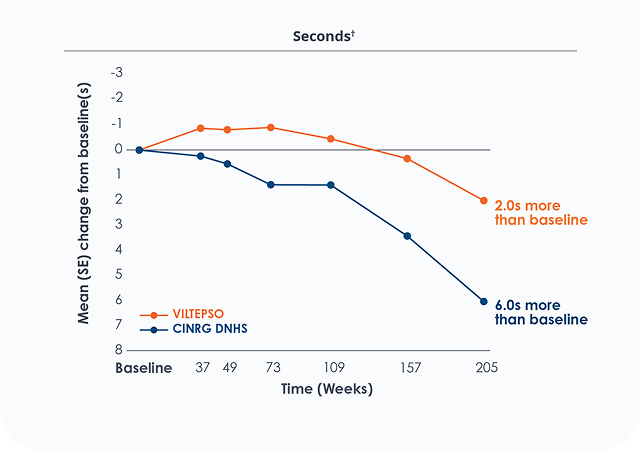
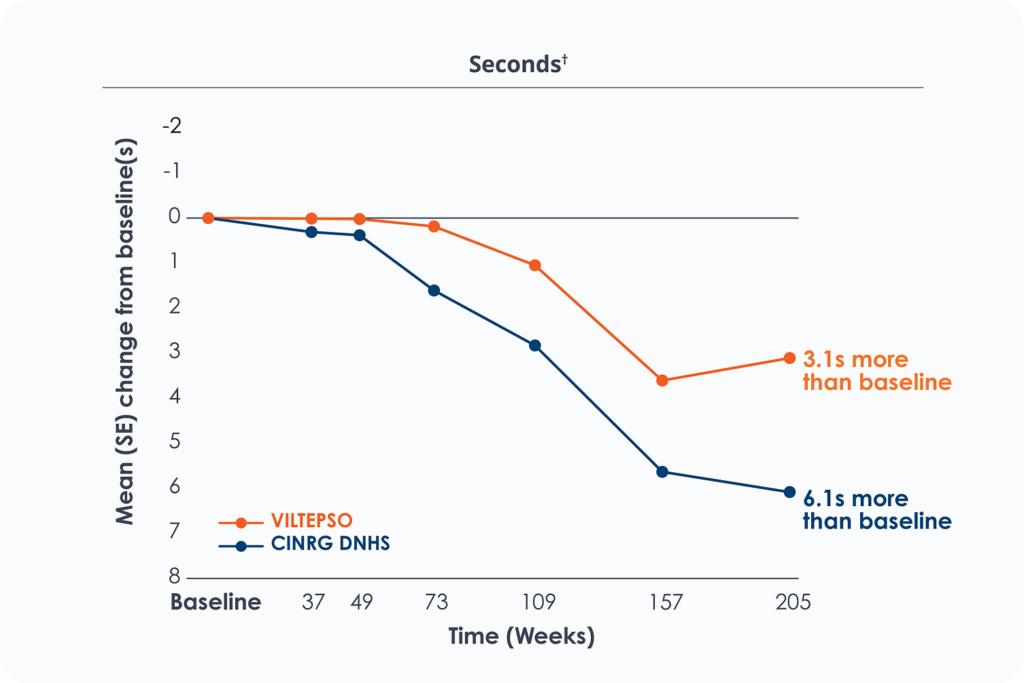
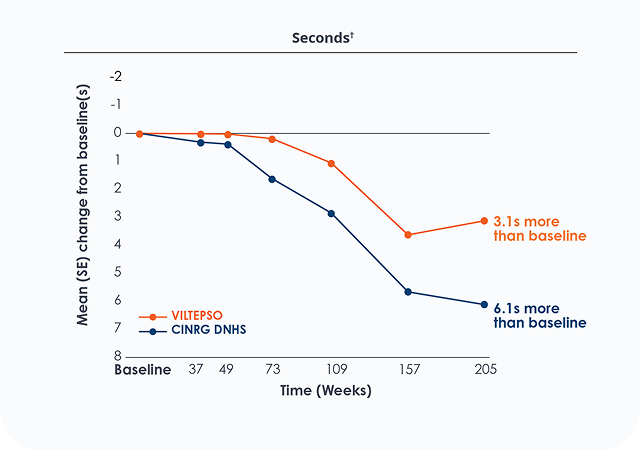
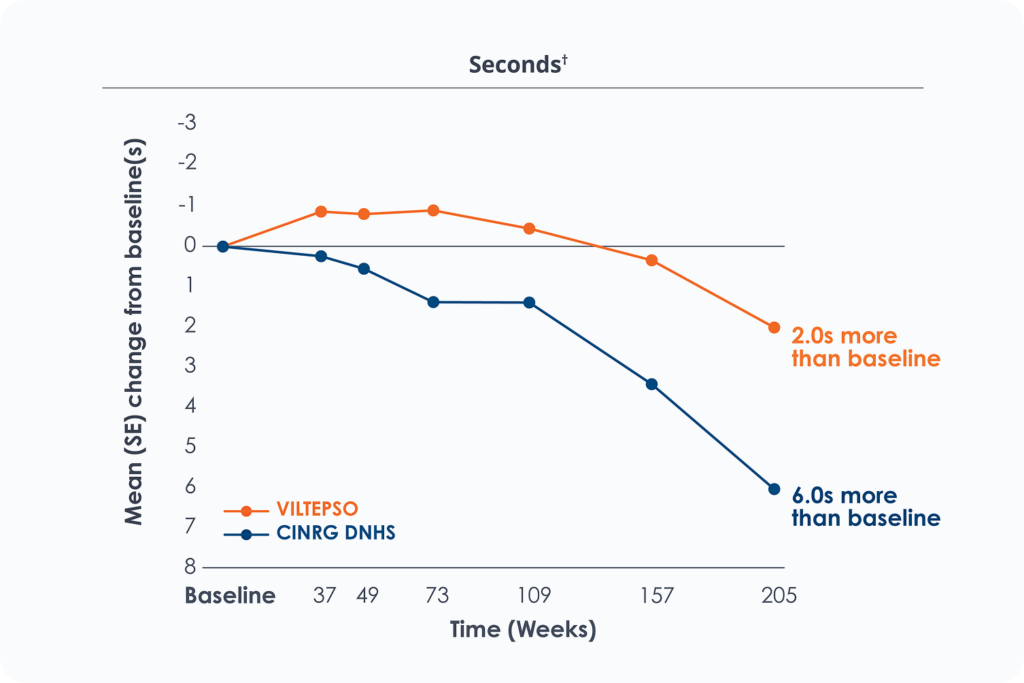
Functional tests were compared to Duchenne natural history data as the control group rather than to placebo. Functional data are not in the US Prescribing Information.
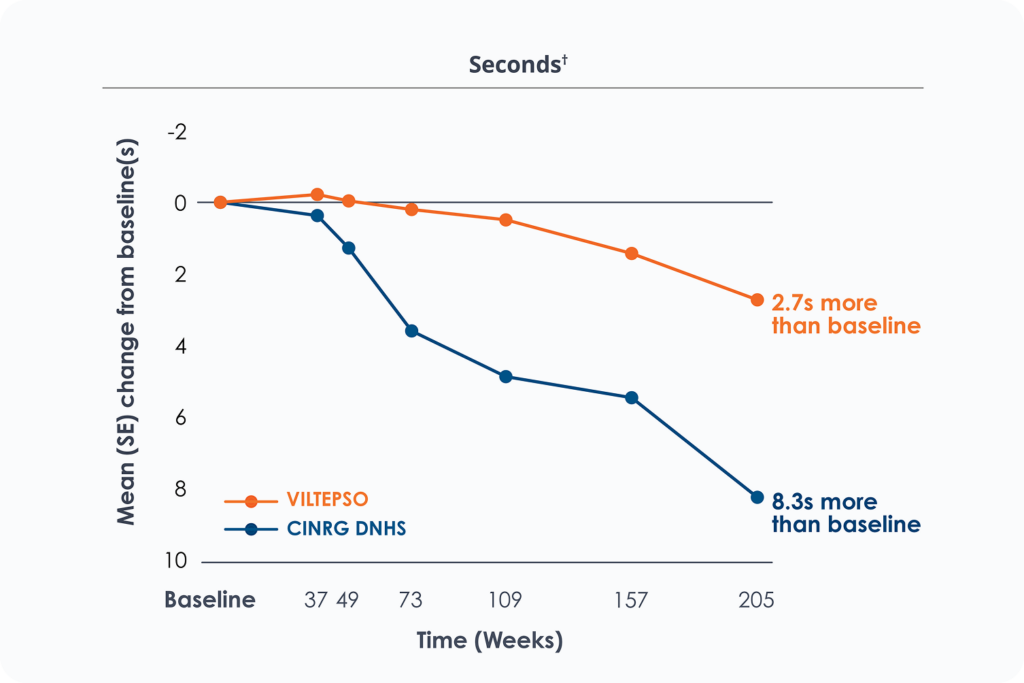
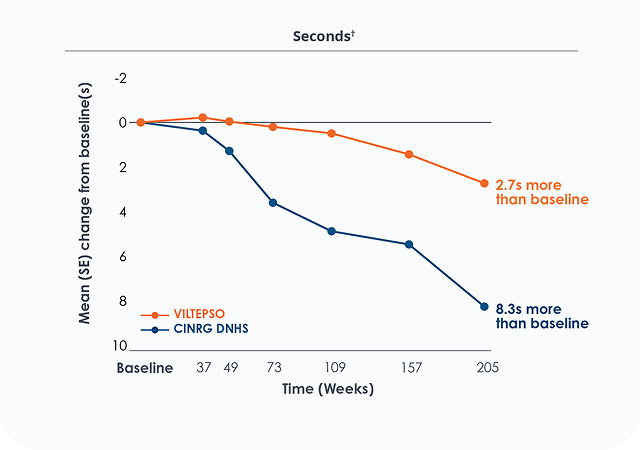
Line charts showing long-term functional assessment data for VILTEPSO (viltolarsen)-treated DMD patients over 192 weeks: time to stand, time to run/walk 10 meters and time to climb four stairs versus Duchenne natural history comparator data.

*The control subjects for this trial were matched for age, ambulatory status, corticosteroid use, and geographic location from the CINRG DNHS registry.

Negative time means less time; positive time means more time.

CINRG=Cooperative International Neuromuscular Research Group; DNHS=Duchenne Natural History Study.

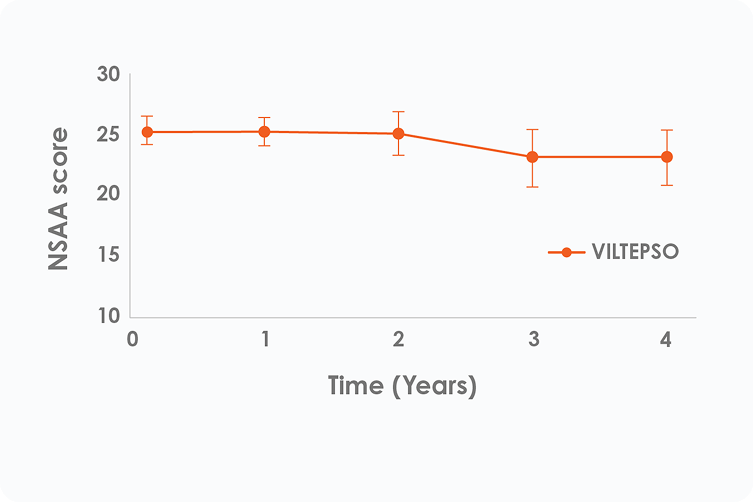
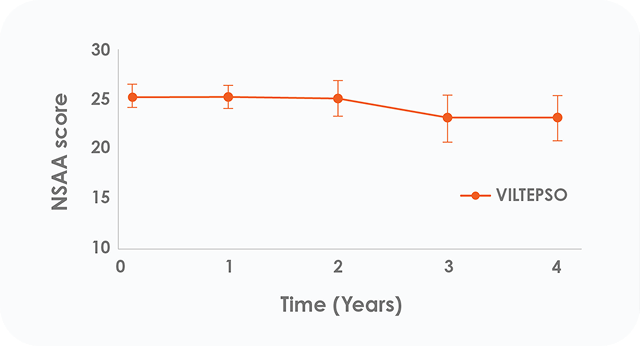
Line chart showing North Star Ambulatory Assessment scores over time for DMD patients treated with VILTEPSO (viltolarsen).

KEY INSIGHT

Scores typically start to decline in DMD patients after age six.

LONG-TERM DATA

North Star Ambulatory Assessment (NSAA)

NSAA is a validated 34-point scale for assessing motor function in ambulant DMD patients, using 17 physical tests to evaluate disease status and document response to therapy in a clinical trial.

  • NSAA was added to the CINRG DNHS protocol later in the study; the CINRG DNHS comparator group did not have sufficient data on NSAA for comparison. Functional data are not in the US Prescribing Information.
NSAA is used to assess motor function in ambulatory patients with DMD. It includes 17 physical tests, each scored from 0 to 2 based on the patient’s performance, for a validated 34-point scale. The NSAA takes about 10 to 15 minutes and is suitable for both specialist clinics and community settings.  
NSAA scores: 
0=Unable to perform the task independently 
1=Able to perform the task with assistance
2=Able to perform the task without assistance

VILTEPSO Safety
Evaluation from
Long-Term Study

Side effects with VILTEPSO were mild or moderate, with no treatment-related serious adverse events.

*VILTEPSO Participants
Participants with:
40 mg/kg/wk
n=8
80 mg/kg/wk
n=8
Total N=16
Any TEAE, n (%)8 (100)8 (100)16 (100)
Any drug-related TEAE,
n (%)
01 (13)1 (6)
Any serious treatment-related AE, n (%)000
Study drug
discontinuation due to
TEAE, n (%)
000
Death, n (%)000
AE=adverse event;
TEAE=treatment-emergent adverse event;
wk=week
Pivotal Study of viltolarsen (VILTEPSO) in DMD

Pivotal Study

Explore results from the 24-week study of VILTEPSO in amenable DMD patients.
Galactic53 Study of viltolarsen (VILTEPSO): pulmonary and upper limb function in DMD

Galactic53: Pulmonary & Upper Limb Function

Explore pulmonary, upper limb, and safety data from the Galactic53 study in ambulatory and non-ambulatory DMD patients.